
Europe Embraces AI as Firms Explore New Digital Frontiers
Artificial intelligence is spreading rapidly among European firms reshaping how business processes are managed and scaled. Harmonised surveys in Germany Italy and Spain provide unique insights into AI adoption across comparable firm populations. These surveys allow researchers to analyse patterns that general statistics alone cannot reveal.
Firm-level adoption data is critical for understanding how AI affects productivity growth and competitiveness across sectors. Differences in firm size sector and digital maturity shape adoption patterns and intensity of use. This level of detail helps policymakers design measures that support efficient technology diffusion.
Early evidence shows adoption rates vary sharply across countries and industries with experimental usage being most common. Germany leads in both general and generative AI adoption while Italy and Spain follow with slower uptake. Larger and more productive service firms show higher adoption while manufacturing adoption remains uneven. Patterns suggest AI is primarily a tool for process improvement rather than comprehensive business transformation at this stage.
Understanding these early patterns sets the stage for exploring complementarities with other technologies such as cloud computing and robotics. Adoption trajectories indicate that early experimentation is often a stepping stone toward more systematic integration. Firms testing AI now are likely to become frontrunners in digital innovation over the coming years. The next section examines how firm characteristics shape adoption across countries and sectors.
Rapid AI Uptake Reveals Size Sector and Country Patterns
Harmonised surveys in Germany Italy and Spain reveal substantial differences in AI adoption across countries. In 2024 only a small share of Italian firms reported using AI compared with higher rates in Germany and Spain. Generative AI adoption follows a similar pattern with Germany leading significantly ahead of the other two countries.
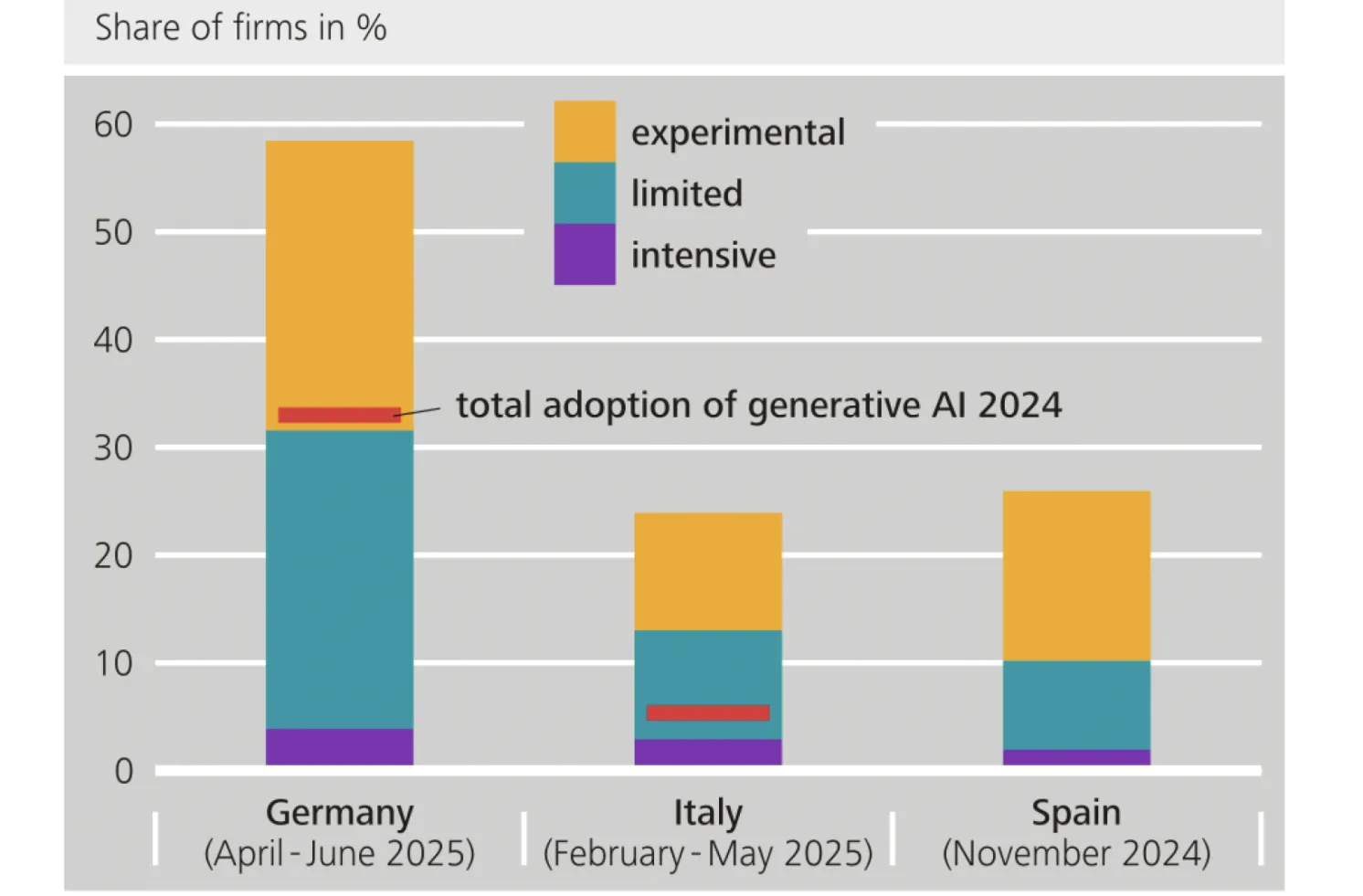
Note: The figure covers firms in industry (excluding construction) and in the non-financial private services sector with at least 20 employees. Generative AI is shown by intensity. For Germany and Italy, the total for 2024 corresponds to the share of firms reporting intensive, limited, or experimental AI adoption (excluding firms that report using only predictive AI) in April-June 2024 (Germany) and February-May 2024 (Italy). Data are weighted using firm weights.
Sources: Bundesbank Online Panel – Firms (BOP-F), April-June 2025; Bank of Italy’s Survey of Industrial and Service Firms (INVIND), February-May 2025; Bank of Spain Business Activity Survey (EBAE), November 2024.
Over the following twelve months adoption rates increased sharply especially for generative AI with Germany reaching over fifty percent. Italy saw an even faster relative increase although absolute adoption remained lower than Germany. Spain experienced moderate growth indicating rapid diffusion is not uniform across Europe. These patterns suggest a fast evolving but uneven landscape of AI adoption.
Firm size strongly correlates with adoption rates larger firms are significantly more likely to experiment with AI than smaller counterparts. Service sector firms show higher adoption rates especially in logistics telecommunications and professional support activities. German manufacturing stands out as a notable exception with adoption nearly matching service sector levels. By contrast Italian and Spanish manufacturing adoption remains considerably lower than their respective service sectors.
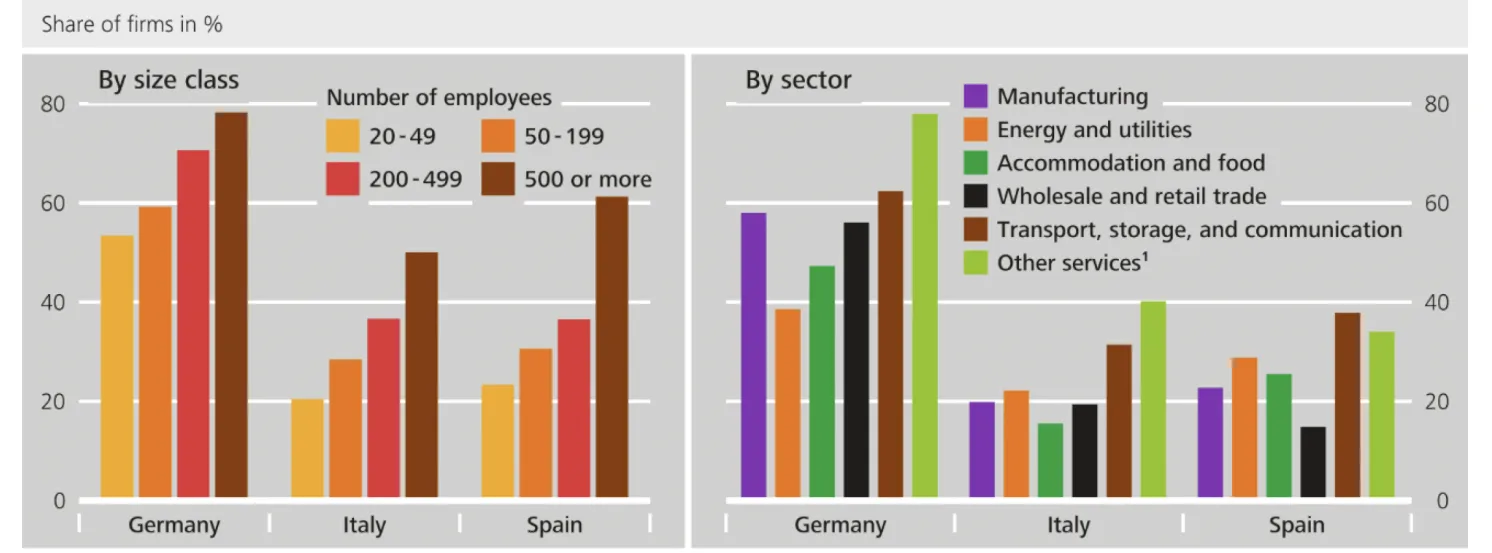
Note: The figure covers firms in industry (excluding construction) and in the non-financial private services sector with at least 20 employees. The share of firms reporting intensive, limited, or experimental AI adoption is shown by firm class size (left panel) and by sector (right panel). Data are weighted using firm weights. 1 Comprises NACE Section L (Real estate activities), Section M (Professional, scientific and technical activities), and Section N (Administrative support and support service activities).
Sources: Bundesbank Online Panel – Firms (BOP-F), April-June 2025; Bank of Italy’s Survey of Industrial and Service Firms (INVIND), February-May 2025; Bank of Spain Business Activity Survey (EBAE), November 2024.
Productivity also influences AI uptake with firms above median turnover per employee more likely to adopt these technologies. Higher productivity may reflect greater resources or digital readiness enabling faster experimentation with AI solutions. Firms that experiment early often move toward more systematic integration in subsequent years. Cross-country similarities suggest size productivity and sector are consistent predictors of adoption patterns.
Despite growing interest adoption remains mostly experimental with intensive use concentrated in a small number of pioneering firms. Less than four percent of firms in all three countries report intensive generative AI usage. Most firms use AI to supplement existing processes rather than overhaul core operations. This limited intensity indicates that widespread structural transformation has not yet occurred.
Differences across countries reflect both structural characteristics and varying levels of digital maturity among firms. Germany benefits from higher digital readiness and established adoption of cloud computing and automation tools. Italy and Spain face structural barriers that slow both experimentation and scaling of AI solutions. Understanding these patterns helps contextualize adoption trajectories across European economies.
Survey results also highlight that early experimentation serves as a stepping stone toward broader adoption and integration. Firms testing AI in 2024 are more likely to increase usage intensity in 2025. This path-dependent process underscores the role of learning in technological adoption. Incremental experimentation reduces risks while building organizational capabilities for systematic AI integration.
Patterns of adoption by sector firm size and productivity indicate that AI diffusion is currently concentrated among a subset of advanced firms. Service firms dominate adoption across countries but German manufacturing illustrates potential for broader uptake. Targeted policies or investment in digital infrastructure could facilitate diffusion in lagging sectors. Early adopters may set benchmarks for productivity and efficiency improvements across Europe.
The evidence from these harmonised surveys sets the stage for examining complementary technologies and early experimentation as drivers of adoption. Cross-country comparisons allow insights into the structural and behavioral factors shaping diffusion patterns. The next section explores how digital maturity and technology complementarity influence the intensity of AI use among European firms.
Digital Maturity and Complementary Technologies Drive Adoption
AI adoption is closely linked to a firm’s existing use of cloud computing and robotics which provide necessary infrastructure. Firms already leveraging these technologies are more likely to experiment with generative AI and integrate it successfully. Digital maturity appears to act as a catalyst rather than a passive factor in adoption.
Prior experimentation with predictive or generative AI significantly increases the likelihood of more systematic adoption in subsequent periods. Italian and German firms that piloted AI in 2024 show higher intensity of use in 2025. This pattern illustrates a path-dependent adoption process where experience facilitates deeper integration. Firms gradually build capabilities to handle AI without disrupting core operations.
Complementarity between technologies is particularly important as AI often requires cloud-based storage and computing power. Robotics complements AI by providing automated processes that can be enhanced through machine learning and predictive analytics. Firms with both cloud and robotics infrastructure experience fewer barriers to scaling AI solutions. Integration becomes smoother because these technologies reinforce one another.
Firms with established technological maturity are better equipped to manage risks associated with AI adoption. Risk management includes avoiding errors operational delays and misalignment with business goals. Experienced firms also better anticipate employee training needs and organizational restructuring. This reduces disruption and enhances the likelihood of sustained adoption over time.
Early experimentation allows firms to evaluate the practical benefits of AI without committing fully to large-scale deployment. These trials help identify areas where AI can improve efficiency or decision-making. Insights gained during experimentation inform broader adoption strategies. Path-dependent learning ensures that firms expand AI use in ways aligned with business objectives.
Complementary technology use and prior experimentation explain much of the variation in adoption intensity across firms. German manufacturing demonstrates higher AI adoption partly due to established robotics and cloud infrastructure. In Italy and Spain service firms lead adoption because they are more likely to combine digital tools. Differences highlight how complementary technologies amplify adoption potential.
Firms often increase AI intensity incrementally after initial trials rather than implementing sweeping changes immediately. This gradual approach reduces operational risk and supports workforce adaptation. Incremental scaling aligns with organizational learning processes. Experimental adoption acts as a bridge to more comprehensive integration.
Digital maturity also fosters innovation culture which encourages continuous improvement and openness to emerging technologies. Firms with mature digital processes are more likely to experiment beyond business support tasks. They identify novel applications and potential productivity gains more effectively. Maturity thus accelerates adoption and reinforces the benefits of experimentation.
These patterns indicate that successful AI adoption depends on both prior technological readiness and strategic experimentation. Firms that combine digital infrastructure experience and learning culture are positioned to become early adopters and innovators. Understanding these drivers helps explain why adoption remains uneven across sectors and countries. The next section examines how firms apply AI primarily for process improvements and task optimization.
Efficiency Gains Shape How Firms Apply AI in Business Processes
Survey evidence shows that most firms primarily use AI to upgrade already automated processes or streamline business support functions. Process improvement remains the dominant objective across countries and sectors. Firms prioritize efficiency gains over developing new products or services at this stage.
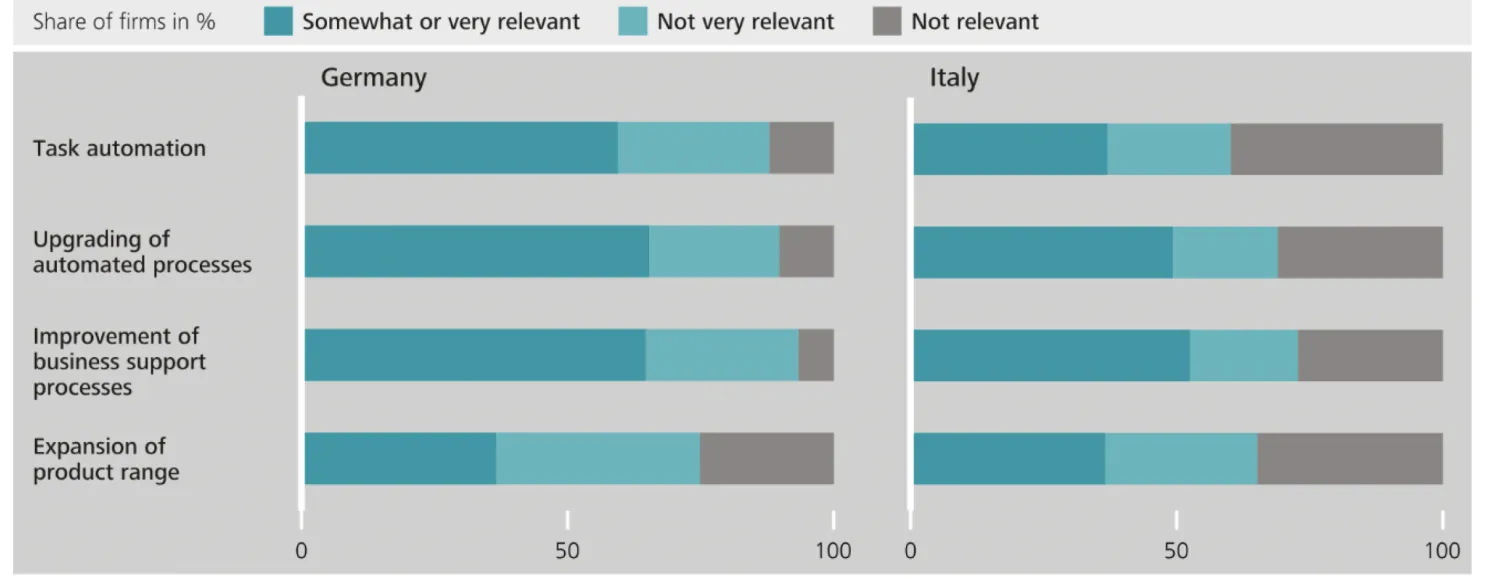
Note: The figure covers firms in industry (excluding construction) and in the non-financial private services sector with at least 20 employees that reported using generative and/or predictive AI in 2024. The share of these firms is shown that rate each objective for AI use as somewhat or very relevant, not very relevant, or not relevant. Data are weighted using firm weights.
Sources: Bundesbank Online Panel – Firms (BOP-F), April-June 2025; Bank of Italy’s Survey of Industrial and Service Firms (INVIND), February-May 2025; Bank of Spain Business Activity Survey (EBAE), November 2024.
Spanish firms report similar trends with most identifying task automation and support function improvements as key goals. Firms using AI expect measurable gains in productivity and operational speed rather than immediate business diversification. These findings indicate that AI adoption is largely incremental and focused on practical efficiency outcomes.
AI is viewed as a tool for reshaping tasks rather than reducing overall employment within organizations. In Italy and Spain most firms anticipate new job opportunities or task redistribution instead of job cuts. This perception reflects a cautious approach to integrating AI within workforce structures. Firms focus on complementing human labor with AI assistance to enhance output and quality.
Smaller or less digitally mature firms adopt AI experimentally while larger and more productive firms integrate it systematically. Integration tends to start with repetitive tasks or administrative functions. Early adoption helps these firms identify processes that benefit most from automation. Over time experimental AI expands to more strategic and complex business processes.
Task reshaping often leads to reallocation of responsibilities and improved workflow efficiency across departments. Firms note that employees focus on higher-value activities while AI handles repetitive or time-consuming tasks. This shift changes job content rather than reducing headcount directly. Reskilling and training initiatives support employees in adapting to new AI-enhanced responsibilities.
Objectives for AI adoption also reveal strong alignment with existing digital maturity and complementary technology use. Firms leveraging cloud computing and robotics find it easier to apply AI to automate processes effectively. Integration of AI builds on prior technological investments to maximize efficiency returns. Adoption is therefore both strategic and operational rather than experimental alone.
Firms report measurable improvements in administrative accuracy reporting speed and decision support as a result of AI. Early experimentation allows organizations to calibrate AI applications for optimal performance. These outcomes reinforce positive feedback loops for expanding AI usage in other areas. Incremental gains strengthen the business case for continued investment in AI tools.
Perceived employment impacts remain largely positive with most firms expecting task redistribution or creation of new roles. Only a small minority foresee reductions in overall employment levels due to AI integration. This reflects a view of AI as a supportive rather than disruptive technology within existing workflows. Human labor continues to play a central role alongside AI-driven enhancements.
The focus on efficiency and task reshaping highlights the early-stage nature of AI adoption across Europe. Firms emphasize support functions and incremental process improvements while exploring broader applications cautiously. Understanding these objectives provides context for policy interventions and business strategies to encourage deeper AI integration.
Uneven Adoption Signals Opportunities and Challenges for European Firms
AI adoption across Europe remains uneven with higher uptake among larger service-sector firms and digitally advanced organizations. German manufacturing represents a notable exception showing substantial adoption despite being outside the service sector. Overall intensive use of generative AI is concentrated among a small group of pioneering firms.
Technological complementarities play a crucial role in adoption with cloud computing robotics and prior AI experimentation reinforcing integration capabilities. Firms combining these technologies achieve higher efficiency gains and smoother implementation of AI solutions. Early experimentation continues to act as a stepping stone toward more systematic adoption over time. These patterns highlight the importance of digital readiness and strategic planning for AI integration.
Despite rapid experimentation AI primarily improves business processes and reshapes tasks rather than reducing overall employment levels. Firms generally anticipate new opportunities for task redistribution and employee upskilling alongside AI deployment. This early-stage adoption signals potential productivity growth while minimizing workforce disruption. Sectoral and country-specific differences suggest targeted policies may accelerate broader diffusion of AI technologies across Europe.
The current adoption landscape has significant implications for innovation competitiveness and digital policy throughout the European economy. Encouraging complementary technology use and experimentation can strengthen firms’ capabilities and global positioning. AI offers opportunities to enhance productivity efficiency and decision-making without replacing human labor entirely. Future adoption is likely to shape both economic performance and organizational transformation across multiple industries.